What's in this guide
- Why Finding the Right Quran Teacher in the UK Matters
- 1. Verified Tajweed Mastery and Accurate Pronunciation
- 2. Fluent English and Cultural Understanding for UK Children
- 3. Dedicated 1-to-1 Lessons vs Crowded Group Calls
- 4. A Step-by-Step Curriculum: From Noorani Qaida to Fluent Tilawat
- 5. Child Safety, Patience, and Encouraging Pedagogy
- 6. Flexible Scheduling Aligned with UK Time Zones
- 7. Transparent Pricing Without Hidden Lock-In Contracts
Why Finding the Right Quran Teacher in the UK Matters
For Muslim families living in the United Kingdom, finding reliable, high-quality Quran tuition for children is one of the most important parental responsibilities. Whether you live in London, Birmingham, Manchester, Bradford, Leeds, Glasgow, or Luton, the options historically involved driving to a local mosque after a tiring school day or relying on community recommendations.
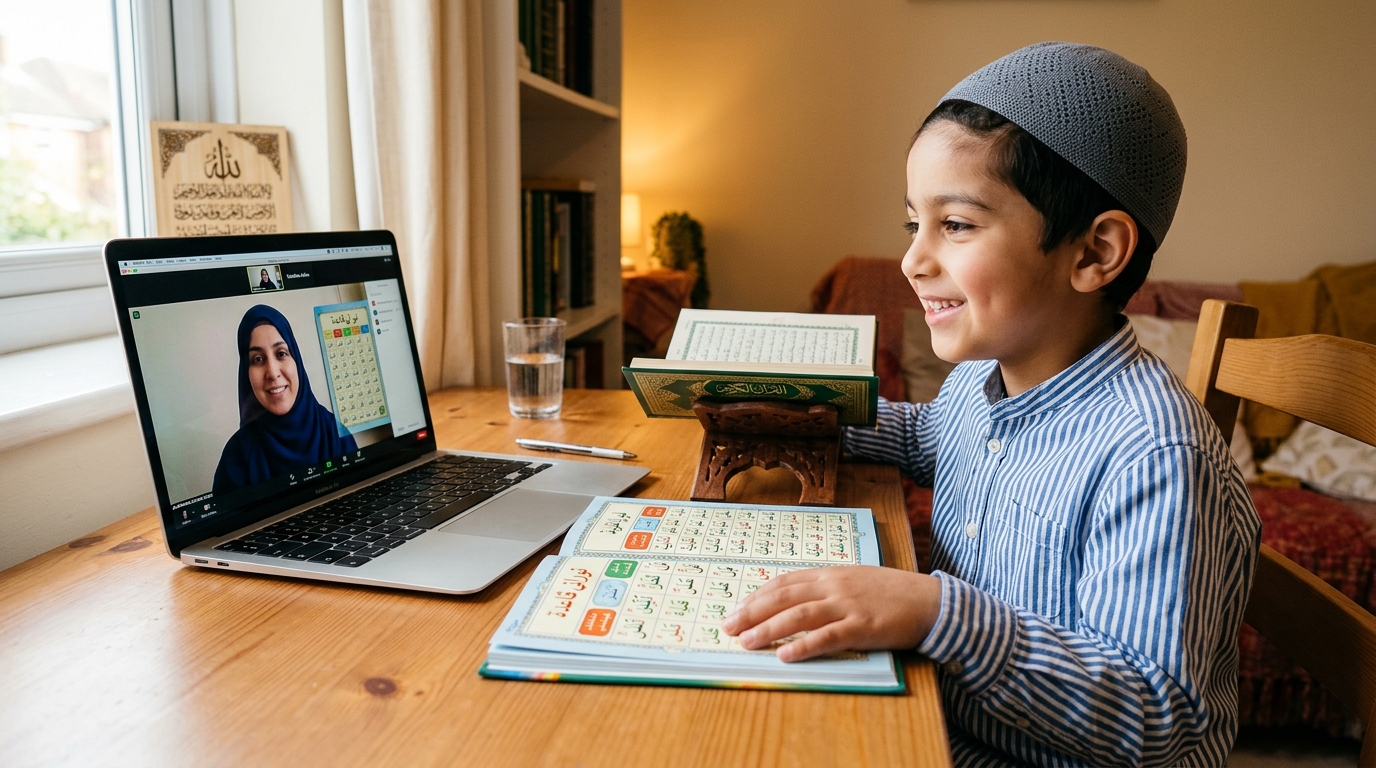
Today, online Quran tuition has transformed Islamic learning across Britain. Instead of sitting in crowded evening madrasahs with 25 pupils per teacher, children can now learn in private 1-to-1 sessions right from their study desk at home. However, with hundreds of tutoring platforms and freelance tutors advertising online, how do you distinguish between an exceptional, caring Qari and an inexperienced tutor who lacks child pedagogy?
This guide outlines the seven non-negotiable criteria British parents should evaluate before selecting an online Quran teacher for their family.
Key Takeaways
1. Verified Tajweed Mastery and Accurate Pronunciation
The primary duty of any Quran teacher is teaching students to recite the words of Allah exactly as revealed, preserving every vowel length, nasal tone (Ghunnah), and articulation point (Makharij).
Arabic letters like ع (Ayn), ح (Haa), ط (Taa), and ض (Daad) have no direct equivalents in the English language. If a teacher does not possess rigorous Tajweed training, they may allow children to pronounce Arabic letters using English approximations. Once incorrect speech habits become ingrained during Noorani Qaida, undoing them years later requires immense effort.
Ask prospective tutors about their background:
- Did they complete formal Qirat and Tajweed certification?
- Are they a certified Hafiz or Qari with experience teaching beginners from zero?
- Can they explain Tajweed rules simply to a child without confusing academic jargon?
2. Fluent English and Cultural Understanding for UK Children
Many well-meaning parents hire overseas tutors who speak limited English. While their Quran recitation may be beautiful, a severe language barrier frequently leaves British-born children feeling disconnected, bored, or intimidated.
British Muslim children grow up in an English-speaking school system. They thrive when their Quran tutor can:
- Explain what words and rules mean using friendly, relatable English.
- Use encouraging pedagogical phrases rather than harsh reprimands.
- Relate to the child's daily schedule, British school terms, and attention spans.
- Communicate clearly with parents over WhatsApp or email regarding lesson progress.
When a teacher speaks fluent English, Quran class becomes an engaging conversation rather than a stressful chore.
3. Dedicated 1-to-1 Lessons vs Crowded Group Calls
One of the greatest drawbacks of traditional evening madrasahs is the pupil-to-teacher ratio. In a room of 20 to 30 students, each child often receives only 3 to 5 minutes of direct recitation time with the teacher. The remaining 45 minutes are spent waiting quietly or getting distracted.
Online group webinars suffer from the same problem:
- Background microphone noise and feedback distract young students.
- Quieter or hesitant children hide behind muted microphones.
- Fast learners get bored, while struggling students fall behind without help.
In contrast, a focused 1-to-1 lesson of 25 to 30 minutes provides 100% undivided attention. Every single syllable your child utters is heard, corrected, and reinforced immediately. Progress with 1-to-1 online tuition is routinely three times faster than in large groups.
4. A Step-by-Step Curriculum: From Noorani Qaida to Fluent Tilawat
An experienced Quran teacher never teaches randomly from page to page. They follow a proven pedagogical roadmap:
- Phase 1: Single Arabic Letters (Lesson 1) — Mastering individual names and sound origins (Makharij).
- Phase 2: Letter Shapes & Joins (Lessons 2–3) — Recognizing letters in initial, medial, and final forms.
- Phase 3: The Short Vowels (Harakat) — Perfecting Fatha, Kasra, and Damma without stretching.
- Phase 4: Tanween & Sukoon — Learning resting letters and double vowel nasal sounds.
- Phase 5: Core Tajweed Rules — Qalqalah, Noon Saakin, Meem Saakin, and Madd rules.
- Phase 6: Nazrah Quran — Transitioning smoothly into the 30th Juz (Juz Amma) of the Holy Quran.
Ask your prospective teacher what syllabus they use. At Ilm by Nouman, we provide 30 interactive online Qaida lessons alongside live classes, allowing children to practice with authentic audio anytime between lessons.
5. Child Safety, Patience, and Encouraging Pedagogy
Fear and harshness have no place in Quranic education. Countless adults carry negative memories of being shouted at or punished during childhood Quran classes, which created resentment toward Islamic learning.
The best Quran teachers embody the prophetic method: gentleness, patience, and warmth. Look for teachers who:
- Celebrate small daily wins: "Mash'Allah, you nailed that heavy Qaaf letter on the first try!"
- Use visual reward systems, digital stickers, or interactive games to keep younger children engaged.
- Maintain a safe, respectful environment where the child feels confident asking questions without fear of being scolded.
- Welcome parents to sit in on lessons or observe anytime.
6. Flexible Scheduling Aligned with UK Time Zones
British family life is busy. Between UK school hours (typically 8:45 AM to 3:30 PM), homework, dinner, and sports clubs, rigid lesson timetables create unnecessary stress.
Look for a tutor who offers flexible scheduling that matches UK time zones (GMT in winter and BST in summer):
- After-school slots between 4:00 PM and 7:30 PM on weekdays.
- Weekend morning slots between 9:00 AM and 1:00 PM.
- Easy rescheduling options if a child falls ill or has exams.
With online lessons, you never waste 40 minutes sitting in UK traffic or waiting outside in rainy weather. Your child simply joins the live call directly from your living room.
7. Transparent Pricing Without Hidden Lock-In Contracts
Cost is a practical consideration for every household. In the UK, face-to-face home tutors often charge between £20 and £35 per hour, making tuition prohibitive for families with multiple children.
Quality online Quran classes provide premium 1-to-1 tuition at a fraction of that cost. Standard packages in the UK typically range from:
- 2 classes per week (approx. 8 lessons/month): £30 to £45 per month.
- 3 classes per week (approx. 12 lessons/month): £40 to £55 per month.
- 5 classes per week (approx. 20 lessons/month): £65 to £85 per month.
Beware of academies that demand 12-month lock-in contracts or charge hefty non-refundable registration fees upfront. Reputable teachers offer monthly subscriptions with the flexibility to cancel or pause anytime.
Frequently Asked Questions
What age is best for a child in the UK to start online Quran lessons?
Children typically start between ages 4 and 6. For four-year-olds, short 20-minute sessions focused on letter games and audio repetition work best. Older children aged 7 and above thrive in standard 30-minute 1-to-1 lessons.
How long does it take for a beginner to finish Noorani Qaida online?
With consistent 1-to-1 lessons 3 to 4 times a week, most children complete Noorani Qaida within 4 to 8 months and begin reading the Holy Quran with proper Tajweed.
Can adult beginners in the UK take online Quran classes too?
Yes! We teach many revert Muslims, university students, and busy working professionals across London, Birmingham, and Manchester who want private, judgment-free classes tailored to adult learning paces.
What equipment is needed for an online lesson?
All you need is a laptop, tablet, or smartphone with a reliable internet connection and headphones. Lessons take place over Zoom or Google Meet with shared screen support.

Written by Qaari Nouman Mehmood
Dedicated Quran & Tajweed instructor teaching Noorani Qaida, pronunciation, and Quran recitation to students across the UK, USA, and worldwide. Read full biography.